
??
| 中文名稱(chēng) | 四分子交聯(lián)體5/四旋蛋白5/四次跨膜蛋白5抗體 |
| 別????名 | NET 4; NET-4; TSPAN 5; NET4; Tetraspan 5; Tetraspan NET 4; Tetraspan NET-4; Tetraspan TM4SF; Tetraspanin 5; Tetraspanin-5; Tetraspanin5; TM4SF9; Transmembrane 4 superfamily member 8; Transmembrane 4 superfamily member 9; TSN5_HUMAN; Tspan-5; TSPAN5.?? |
| 研究領(lǐng)域 | 細(xì)胞生物??神經(jīng)生物學(xué)??信號(hào)轉(zhuǎn)導(dǎo)??干細(xì)胞??通道蛋白??細(xì)胞分化??細(xì)胞骨架??細(xì)胞外基質(zhì)?? |
| 抗體來(lái)源 | Rabbit |
| 克隆類(lèi)型 | Polyclonal |
| 交叉反應(yīng) | Mouse,?Rat,? (predicted: Human,?) |
| 產(chǎn)品應(yīng)用 | WB=1:500-2000?ELISA=1:500-1000?IHC-P=1:100-500?IHC-F=1:100-500?ICC=1:100-500?IF=1:50-200?(石蠟切片需做抗原修復(fù)) not yet tested in other applications. optimal dilutions/concentrations should be determined by the end user. |
| 分?子?量 | 57kDa |
| 細(xì)胞定位 | 細(xì)胞膜? |
| 性????狀 | Liquid |
| 濃????度 | 1mg/ml |
| 免?疫?原 | KLH conjugated synthetic peptide derived from human TSPAN5:21-130/268? |
| 亞????型 | IgG |
| 純化方法 | affinity purified by Protein A |
| 儲(chǔ)?存?液 | 0.01M TBS(pH7.4) with 1% BSA, 0.03% Proclin300 and 50% Glycerol. |
| 保存條件 | Shipped at 4℃. Store at -20 °C for one year. Avoid repeated freeze/thaw cycles. |
| PubMed | PubMed |
| 產(chǎn)品介紹 | NET-4, also known as TSPAN5 or TM4SF9, is a 268 amino acid multi-pass membrane protein that belongs to the tetraspanin family and is thought to play a role in signal transduction events related to cell development, activation, growth and motility. The gene encoding NET-4 maps to human chromosome 4, which encodes nearly 6% of the human genome and has the largest gene deserts (regions of the genome with no protein encoding genes) of all of the human chromosomes. Defects in some of the genes located on chromosome 4 are associated with Huntington's disease, Ellis-van Creveld syndrome, methylmalonic acidemia and polycystic kidney disease. Function: DNA-binding protein that specifically binds heat shockpromoter elements (HSE) and activates transcription. In highereukaryotes, HSF is unable to bind to the HSE unless the cells areheat shocked. Subunit: Monomer. Under normal conditions, interacts with HSP90AA1in the HSP90 multichaperone complex; the interaction preventstrimerization and activation of HSF1. On activation by heat-stressor by other factors such as metal ions, HSF1 is released from thecomplex, homotrimerizes, is hyperphosphorylated and translocated tothe nucleus where, subsequently, it can activate transcription.Binds the complex through the regulatory domain. Interacts withSYMPK and CSTF2 in heat-stressed cells. Interacts with FKBP4 in theHSP90 multichaperone complex; the interaction is independent of thephosphorylation state of HSF1. Interacts with MAPKAPK2. Subcellular Location: Membrane; Multi-pass membrane protein (Probable). Post-translational modifications: Phosphorylated on multiple serine residues, a subset of whichare involved in stress-related regulation of transcriptionactivation. Constitutive phosphorylation represses transcriptionalactivity at normal temperatures. Levels increase on specificresidues heat-shock and enhance HSF1 transactivation activity.Phosphorylation on Ser-307 derepresses activation on heat-stressand in combination with Ser-303 phosphorylation appears to beinvolved in recovery after heat-stress. Phosphorylated on Ser-230by CAMK2, in vitro. Cadmium also enhances phosphorylation at thissite. Phosphorylation on Ser-303 is a prerequisite for HSF1sumoylation. Phosphorylation on Ser-121 inhibits transactivationand promotes HSP90 binding. Phosphorylation on Thr-142 alsomediates transcriptional activity induced by heat. Sumoylated with SUMO1 and SUMO2 on heat-shock. Heat-induciblesumoylation occurs after 15 min of heat-shock, after which levelsdecrease and at 4 hours, levels return to control levels.Sumoylation has no effect on HSE binding nor on transcriptionalactivity. Phosphorylation on Ser-303 is a prerequisite forsumoylation. Similarity: Belongs to the tetraspanin (TM4SF) family. SWISS: P62079 Gene ID: 10098 Database links: Entrez Gene: 10098?Human Entrez Gene: 56224?Mouse Entrez Gene: 362048?Rat Omim: 613136?Human SwissProt: Q17QJ5?Cow SwissProt: P62079?Human SwissProt: P62080?Mouse SwissProt: Q68VK5?Rat Unigene: 118118?Human Unigene: 31927?Mouse Unigene: 98240?Rat Important Note: This product as supplied is intended for research use only, not for use in human, therapeutic or diagnostic applications. ? |
| 產(chǎn)品圖片 | 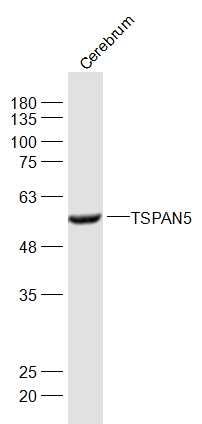 Sample: Sample:Cerebrum (Rat) Lysate at 40 ug Primary: Anti-TSPAN5 (bs-9414R) at 1/1000 dilution Secondary: IRDye800CW Goat Anti-Rabbit IgG at 1/20000 dilution Predicted band size: 57 kD Observed band size: 57 kD 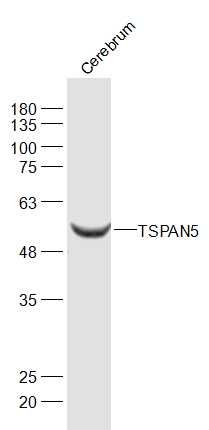 Sample: Sample:Cerebrum (Mouse) Lysate at 40 ug Primary: Anti-TSPAN5 (bs-9414R) at 1/1000 dilution Secondary: IRDye800CW Goat Anti-Rabbit IgG at 1/20000 dilution Predicted band size: 57 kD Observed band size: 57 kD 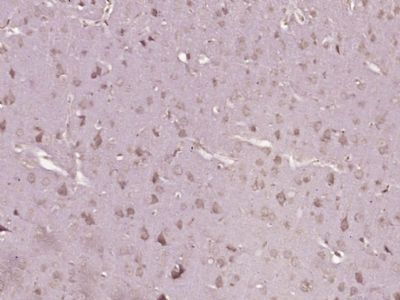 Paraformaldehyde-fixed, paraffin embedded (Mouse brain); Antigen retrieval by boiling in sodium citrate buffer (pH6.0) for 15min; Block endogenous peroxidase by 3% hydrogen peroxide for 20 minutes; Blocking buffer (normal goat serum) at 37°C for 30min; Antibody incubation with (TSPAN5) Polyclonal Antibody, Unconjugated (bs-9414R) at 1:400 overnight at 4°C, followed by operating according to SP Kit(Rabbit) (sp-0023) instructionsand DAB staining. Paraformaldehyde-fixed, paraffin embedded (Mouse brain); Antigen retrieval by boiling in sodium citrate buffer (pH6.0) for 15min; Block endogenous peroxidase by 3% hydrogen peroxide for 20 minutes; Blocking buffer (normal goat serum) at 37°C for 30min; Antibody incubation with (TSPAN5) Polyclonal Antibody, Unconjugated (bs-9414R) at 1:400 overnight at 4°C, followed by operating according to SP Kit(Rabbit) (sp-0023) instructionsand DAB staining.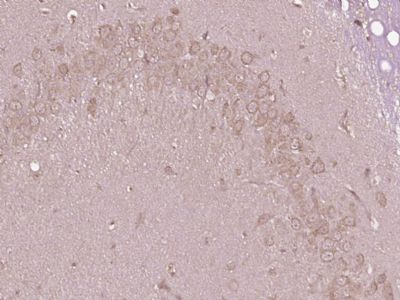 Paraformaldehyde-fixed, paraffin embedded (Rat brain); Antigen retrieval by boiling in sodium citrate buffer (pH6.0) for 15min; Block endogenous peroxidase by 3% hydrogen peroxide for 20 minutes; Blocking buffer (normal goat serum) at 37°C for 30min; Antibody incubation with (TSPAN5) Polyclonal Antibody, Unconjugated (bs-9414R) at 1:400 overnight at 4°C, followed by operating according to SP Kit(Rabbit) (sp-0023) instructionsand DAB staining. Paraformaldehyde-fixed, paraffin embedded (Rat brain); Antigen retrieval by boiling in sodium citrate buffer (pH6.0) for 15min; Block endogenous peroxidase by 3% hydrogen peroxide for 20 minutes; Blocking buffer (normal goat serum) at 37°C for 30min; Antibody incubation with (TSPAN5) Polyclonal Antibody, Unconjugated (bs-9414R) at 1:400 overnight at 4°C, followed by operating according to SP Kit(Rabbit) (sp-0023) instructionsand DAB staining. |
?