
??
| 中文名稱 | 磷酸化谷氨酸受體1抗體 |
| 別????名 | p-GluR-1(Ser 863); p-GluR1(Ser863); Glutamate Receptor 1 (phospho S863); Glutamate Receptor 1 (phospho Ser863); GLUR 1; GLUR A; AMPA 1; GluR-1; AMPA selective glutamate receptor 1; AMPA-selective glutamate receptor 1; GluA1; GLUH 1; GLUH1; GluR K1; GluR-1; GluR-A; GluR-K1; GLUR1; GLURA; GluRK1; Glutamate receptor 1; Glutamate receptor ionotropic AMPA 1; Glutamate receptor ionotropic; Glutamate receptor, ionotropic, AMPA 1; Gria 1; Gria1; GRIA1_HUMAN; HBGR1; MGC133252; OTTHUMP00000160643; OTTHUMP00000165781; OTTHUMP00000224241; OTTHUMP00000224242; OTTHUMP00000224243.?? |
| 產(chǎn)品類型 | 磷酸化抗體? |
| 研究領(lǐng)域 | 腫瘤??細(xì)胞生物??免疫學(xué)??神經(jīng)生物學(xué)??信號(hào)轉(zhuǎn)導(dǎo)??轉(zhuǎn)錄調(diào)節(jié)因子??細(xì)胞膜受體?? |
| 抗體來源 | Rabbit |
| 克隆類型 | Polyclonal |
| 交叉反應(yīng) | Human,?Mouse,?Rat,? (predicted: Dog,?Pig,?Cow,?Horse,?Rabbit,?Sheep,?) |
| 產(chǎn)品應(yīng)用 | WB=1:500-2000?ELISA=1:500-1000?IHC-P=1:100-500?IHC-F=1:100-500?ICC=1:100-500?IF=1:100-500?(石蠟切片需做抗原修復(fù)) not yet tested in other applications. optimal dilutions/concentrations should be determined by the end user. |
| 分?子?量 | 98kDa |
| 細(xì)胞定位 | 細(xì)胞漿?細(xì)胞膜? |
| 性????狀 | Liquid |
| 濃????度 | 1mg/ml |
| 免?疫?原 | KLH conjugated synthesised phosphopeptide derived from human GluR1 around the phosphorylation site of Ser863:RN(p-S)GA? |
| 亞????型 | IgG |
| 純化方法 | affinity purified by Protein A |
| 儲(chǔ)?存?液 | 0.01M TBS(pH7.4) with 1% BSA, 0.03% Proclin300 and 50% Glycerol. |
| 保存條件 | Shipped at 4℃. Store at -20 °C for one year. Avoid repeated freeze/thaw cycles. |
| PubMed | PubMed |
| 產(chǎn)品介紹 | Glutamate receptors are the predominant excitatory neurotransmitter receptors in the mammalian brain and are activated in a variety of normal neurophysiologic processes. These receptors are heteromeric protein complexes with multiple subunits, each possessing transmembrane regions, and all arranged to form a ligand-gated ion channel. The classification of glutamate receptors is based on their activation by different pharmacologic agonists. This gene belongs to a family of alpha-amino-3-hydroxy-5-methyl-4-isoxazole propionate (AMPA) receptors. Alternatively spliced transcript variants encoding different isoforms have been found for this gene. [provided by RefSeq, Jul 2008]. Function: Ionotropic glutamate receptor. L-glutamate acts as an excitatory neurotransmitter at many synapses in the central nervous system. Binding of the excitatory neurotransmitter L-glutamate induces a conformation change, leading to the opening of the cation channel, and thereby converts the chemical signal to an electrical impulse. The receptor then desensitizes rapidly and enters a transient inactive state, characterized by the presence of bound agonist. Subunit: Homotetramer or heterotetramer of pore-forming glutamate receptor subunits. Tetramers may be formed by the dimerization of dimers. Interacts with DLG1 via its C-terminus. Interacts with SYNDIG1 and GRIA2. Interacts with LRFN. Interacts with HIP1 and RASGRF2. Found in a complex with GRIA2, GRIA3, GRIA4, CNIH2, CNIH3, CACNG2, CACNG3, CACNG4, CACNG5, CACNG7 and CACNG8. Interacts with CACNG5. Interacts with CNIH2 and CACNG2. Subcellular Location: Cell membrane. Endoplasmic reticulum membrane. Tissue Specificity: Widely expressed in brain. Post-translational modifications: Palmitoylated. Depalmitoylated upon glutamate stimulation. Cys-603 palmitoylation leads to Golgi retention and decreased cell surface expression. In contrast, Cys-829 palmitoylation does not affect cell surface expression but regulates stimulation-dependent endocytosis. Similarity: Belongs to the glutamate-gated ion channel (TC 1.A.10.1) family. GRIA1 subfamily. SWISS: P42261 Gene ID: 2890 Database links: Entrez Gene: 2890?Human Entrez Gene: 14799?Mouse Entrez Gene: 50592?Rat Omim: 138248?Human SwissProt: P42261?Human SwissProt: P23818?Mouse SwissProt: P19490?Rat Unigene: 519693?Human Unigene: 4920?Mouse Unigene: 29971?Rat Important Note: This product as supplied is intended for research use only, not for use in human, therapeutic or diagnostic applications. ? |
| 產(chǎn)品圖片 | 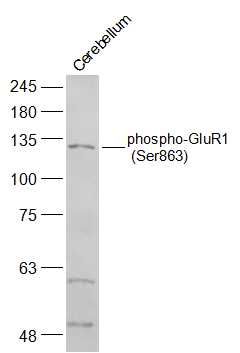 Sample: Sample:Cerebellum (Mouse) Lysate at 40 ug Primary: Anti-phospho-GluR1 (Ser863) (bs-11632R) at 1/500 dilution Secondary: IRDye800CW Goat Anti-Rabbit IgG at 1/20000 dilution Predicted band size: 98 kD Observed band size: 128 kD 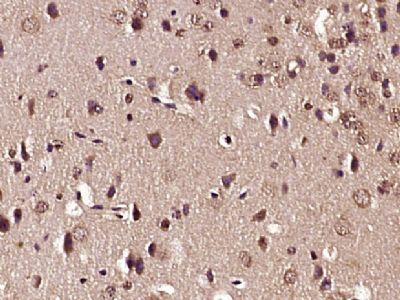 Paraformaldehyde-fixed, paraffin embedded (mouse brain tissue); Antigen retrieval by boiling in sodium citrate buffer (pH6.0) for 15min; Block endogenous peroxidase by 3% hydrogen peroxide for 20 minutes; Blocking buffer (normal goat serum) at 37°C for 30min; Antibody incubation with (GluR1 (Ser863)) Polyclonal Antibody, Unconjugated (bs-11632R) at 1:400 overnight at 4°C, followed by operating according to SP Kit(Rabbit) (sp-0023) instructionsand DAB staining. Paraformaldehyde-fixed, paraffin embedded (mouse brain tissue); Antigen retrieval by boiling in sodium citrate buffer (pH6.0) for 15min; Block endogenous peroxidase by 3% hydrogen peroxide for 20 minutes; Blocking buffer (normal goat serum) at 37°C for 30min; Antibody incubation with (GluR1 (Ser863)) Polyclonal Antibody, Unconjugated (bs-11632R) at 1:400 overnight at 4°C, followed by operating according to SP Kit(Rabbit) (sp-0023) instructionsand DAB staining.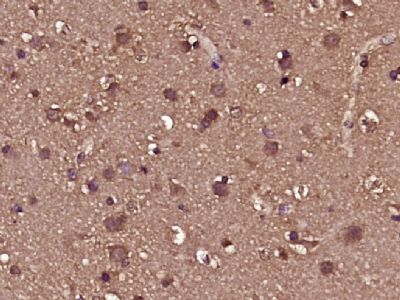 Paraformaldehyde-fixed, paraffin embedded (human glioma tissue); Antigen retrieval by boiling in sodium citrate buffer (pH6.0) for 15min; Block endogenous peroxidase by 3% hydrogen peroxide for 20 minutes; Blocking buffer (normal goat serum) at 37°C for 30min; Antibody incubation with (GluR1 (Ser863)) Polyclonal Antibody, Unconjugated (bs-11632R) at 1:400 overnight at 4°C, followed by operating according to SP Kit(Rabbit) (sp-0023) instructionsand DAB staining. Paraformaldehyde-fixed, paraffin embedded (human glioma tissue); Antigen retrieval by boiling in sodium citrate buffer (pH6.0) for 15min; Block endogenous peroxidase by 3% hydrogen peroxide for 20 minutes; Blocking buffer (normal goat serum) at 37°C for 30min; Antibody incubation with (GluR1 (Ser863)) Polyclonal Antibody, Unconjugated (bs-11632R) at 1:400 overnight at 4°C, followed by operating according to SP Kit(Rabbit) (sp-0023) instructionsand DAB staining.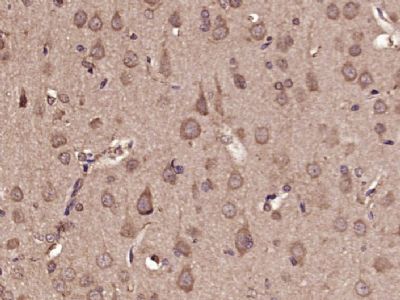 Paraformaldehyde-fixed, paraffin embedded (rat brain tissue); Antigen retrieval by boiling in sodium citrate buffer (pH6.0) for 15min; Block endogenous peroxidase by 3% hydrogen peroxide for 20 minutes; Blocking buffer (normal goat serum) at 37°C for 30min; Antibody incubation with (GluR1 (Ser863)) Polyclonal Antibody, Unconjugated (bs-11632R) at 1:400 overnight at 4°C, followed by operating according to SP Kit(Rabbit) (sp-0023) instructionsand DAB staining. Paraformaldehyde-fixed, paraffin embedded (rat brain tissue); Antigen retrieval by boiling in sodium citrate buffer (pH6.0) for 15min; Block endogenous peroxidase by 3% hydrogen peroxide for 20 minutes; Blocking buffer (normal goat serum) at 37°C for 30min; Antibody incubation with (GluR1 (Ser863)) Polyclonal Antibody, Unconjugated (bs-11632R) at 1:400 overnight at 4°C, followed by operating according to SP Kit(Rabbit) (sp-0023) instructionsand DAB staining. |
?